
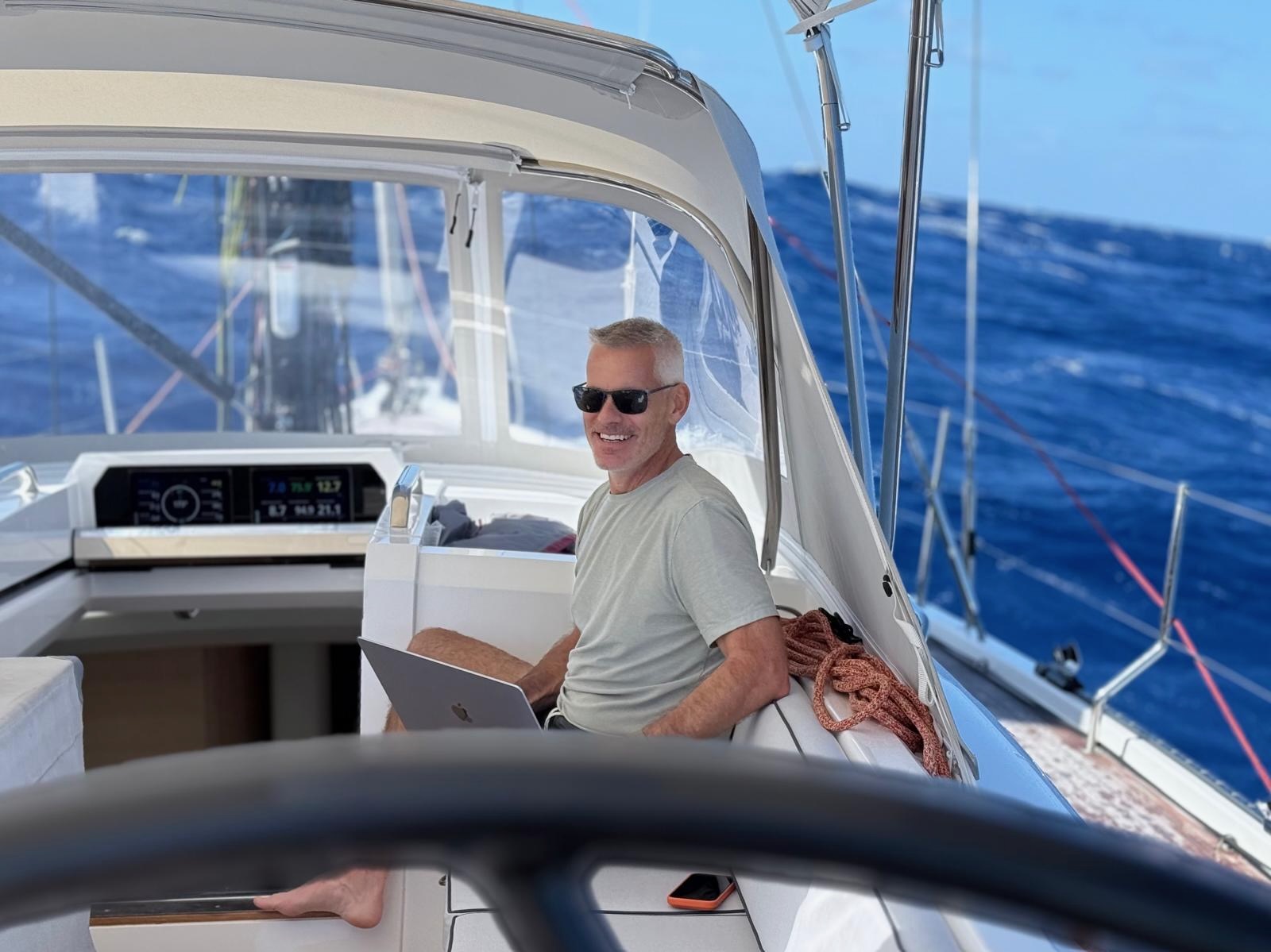
Beloved Reader:
Remember last post when I snarked on how sailors love to complicate the English language unnecessarily? Well, I’ve learned something else about them. They also have a talent for taking something that is infinitely complicated and somehow making it sound simple.
Here are some more observations from SV Welcome.
On the Infinite Line Spaghetti Monster
Let’s start with sails. It’s called a “sailboat” so you think that maybe it has “a” sail. But I saw cartoon drawings of sailboats and noted they often have 2 triangles – so…2? God no. There are…so many.
I’m not sure Jay & Donna even know how many sails they have. They have sails like I have LEGOs.
There’s the main. There’s the jib (or genoa, or headsail—pick your favorite word and pretend you know the difference). There’s a big light-wind thing that lives in a bag that weighs 400 lbs and only comes out when everyone is feeling brave and the wind is behaving (uh-huh). And there’s some “mystery sail” lurking in a locker that people talk about using but never quite agree on how.
Each of these sails comes with its own collection of lines. Sheets, halyards, reef lines, outhauls, inhauls, downhauls. At some point you stop trying to remember the names and just mentally refer to them as:
- The fat red one
- The skinny green one
- The blue one that always seems to be under something else
- “No, not that black one, stupid!”
Jay & Donna, wisely, color-coded everything. This helps…a little. It reduces the odds that you’ll grab a completely wrong line to about 70 percent instead of 100. The problem is that there are still more lines than seems strictly necessary to move one boat in one direction.
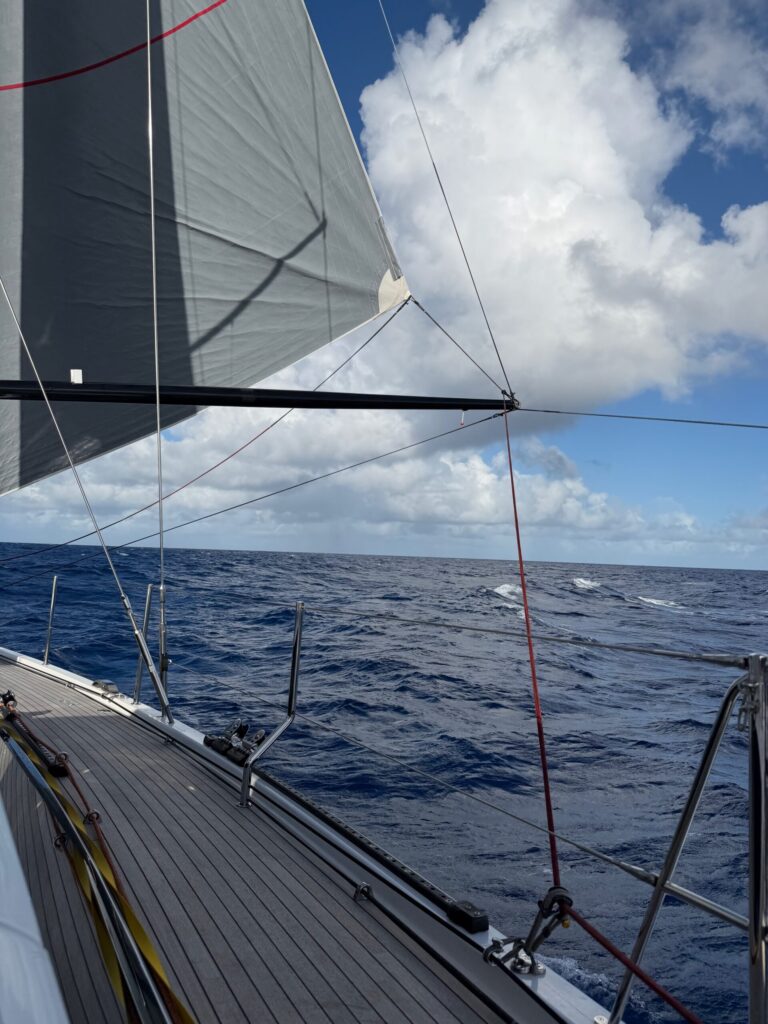
Changing sails or reefing isn’t a single action. It’s a process: someone says, “Let’s reef the main,” in the same tone you’d use for “Let’s make another pot of coffee.” Then suddenly five different lines are moving at once, the winches are screaming, something is flapping loudly enough to wake the dead, and you’re trying to remember if your job was “pull” or “let go.”
When we finish, the boat usually looks about right, but we almost always end up tweaking something. A little more tension here, a little less there, a line that should be snugged up, another one that’s clearly doing nothing except existing for future tripping hazards. The dreaded “chafing” – which at least I understand based on a long sweaty walk in New Orleans once.
The funny thing is, after a while, you start to get it. You still don’t know all the sail names, but you know which line to grab when someone yells, “Ease that!”
And on an ocean crossing, that’s progress.
Spaceship Electronics
If the deck feels like a spaghetti experiment with ropes, the inside of the Oyster feels like you’ve accidentally wandered onto a small spaceship designed by Apple.
Secretly this is my favorite bit of the sailing. The nerd in me just loves the electronics, the data. The endless ways to customize and learn about how the boat works. It’s good, too, since I’ve somehow become the IT guy on the boat.
There are B&G Screens everywhere. At the helm. Down below. On the stairs. Glowing at you in the dark like very confident, very opinionated iPads. They show charts, wind, speed, depth, tide, other boats, weather—basically everything except your current level of imposter syndrome.
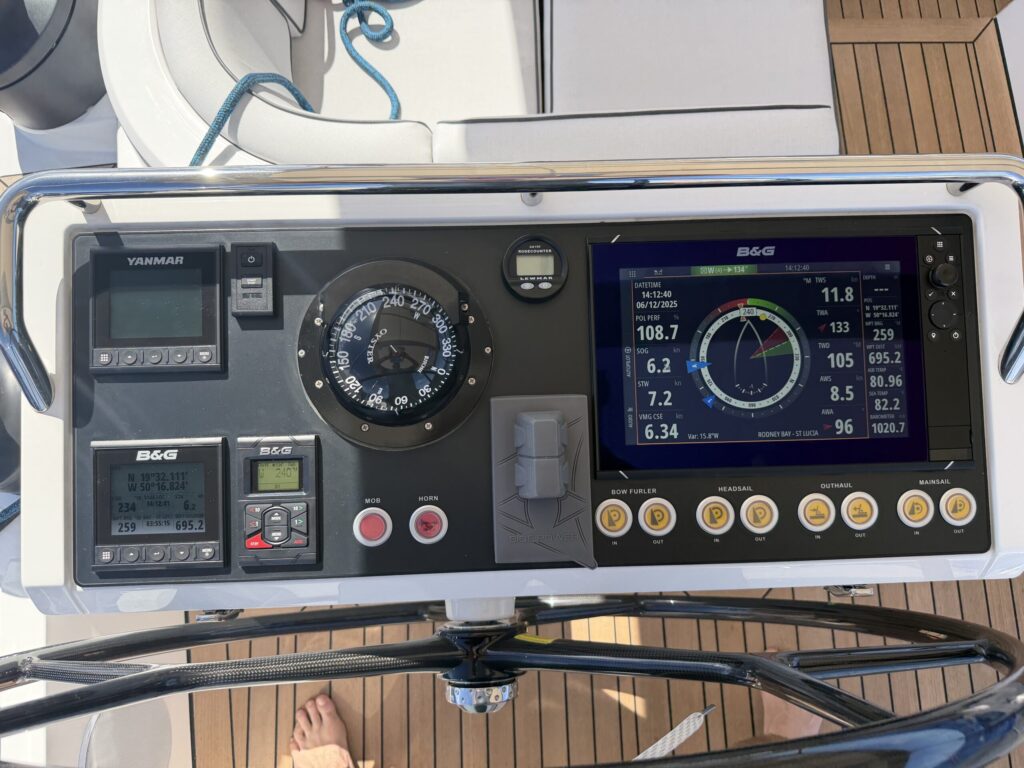
And the acronyms. TWS. AWS. TWD. AWA. SOG.
SMA. (So…Many…Acronyms. Get it?)
The chartplotter is the star of the show. You zoom in, you zoom out, and suddenly your entire world is represented by a tiny boat icon on a glowing digital ocean with magical lines guiding you to your destination. Donna or Jay set a waypoint at the nav station and the system draws a neat little line for you to follow.
HAHAHAHA – did I say “a line for you to follow”? No way, dude. You can’t be trusted to turn the big wheel.
I meant AUTOHELM! It’s like autopilot for the seas.
It’s basically a robot intern: does all the boring driving, never complains, and only asks for attention when something is seriously wrong. Turning on autohelm is the sailing equivalent of hitting cruise control, ordering a snack, and pretending you’re still doing something very important.
Marine radar is where things really start to feel like science fiction. In the dark or in rain, you stare at a circular screen with blobs on it, and those blobs are ships, land, or weather. The boat sends out invisible pulses, listens for echoes, and turns that into a picture of what’s around you. In normal life, this would be called magic. At sea, it’s called “pretty handy, actually.”
Then there’s the weather info. Forecasts, wind arrows, pressure systems sliding across your route like villainous cartoon characters. You still look out at the sea (or at the sky), but having the boat whisper, “Hey, this might get sporty later” is not the worst thing.
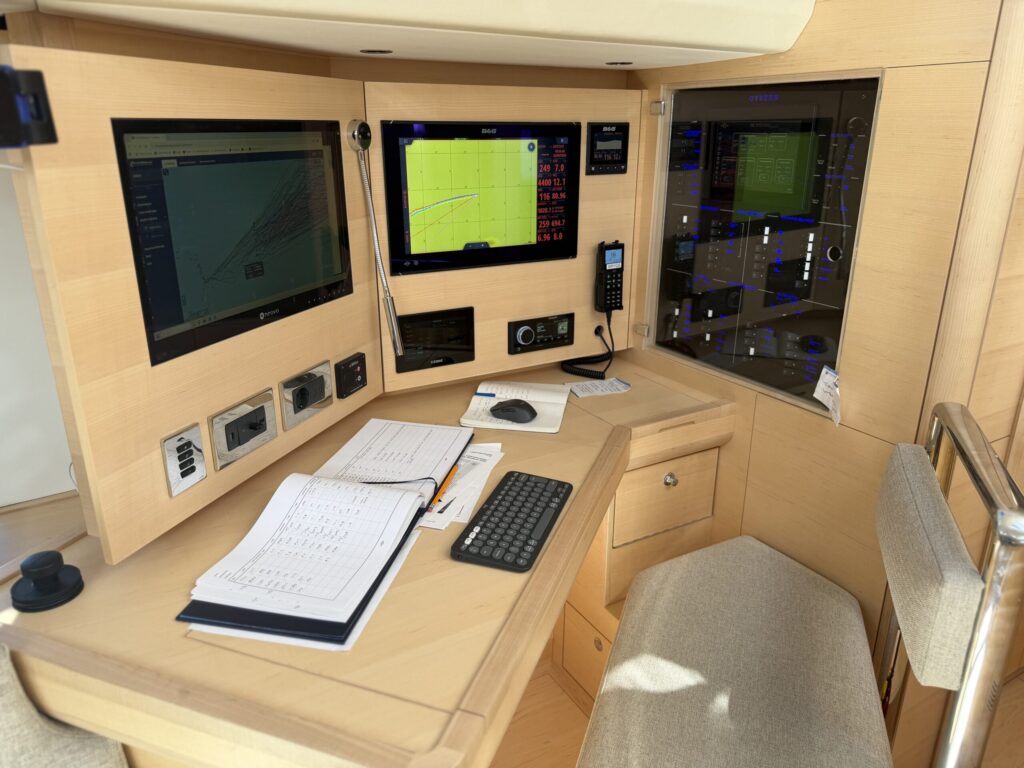
Taken together, all the electronics turn the boat into something that feels far more advanced than anything that should trust someone like you with its buttons. It’s like sailing with a very calm, very patient co‑pilot who quietly knows everything and lets you take the credit when it all works out.
Squalls
Talking about getting sporty. If you want to know how comfortable you normally are out there, wait for your first squall.
A squall is basically a fast-moving, compact temper tantrum of weather. The wind picks up suddenly, the rain goes from zero to car-wash in seconds, and visibility drops so fast you feel like someone turned the world’s dimmer switch to “off.”
The good news: most of the time, you can see them coming. On radar, they show up as big, juicy blobs. To the naked eye, it’s a dark, looming curtain of rain with that “I’m headed your way” look. Sometimes the air feels cooler just before it hits, like the ocean is taking a deep breath.
When someone spots one, there’s a very simple process:
First, denial: “I think it’s going to miss us.”
Then, acceptance: “It’s not going to miss us.”
Then, action: “Crap. Reef the sails. Get your gear on.”
Jay says the proper time to reef is when the word reef first pops into your head. That’s wisdom right there.
Reefing basically means shrinking your sails so the boat doesn’t try to lie over on its side out of sheer enthusiasm. You don’t need to know the details to understand the vibe (I don’t, God knows): but – less sail, more control. You shorten things up, tighten things down, and make sure every loose item on deck won’t become a projectile. Close up any hatches or doors.
Next comes the costume change. Foul weather gear. Lifejackets. Tethers clipped in. The boat goes from “sunny afternoon stroll” to “North Sea fisherman cosplay” in about five minutes.
When the squall hits, it’s loud. The wind howls, the rain is so heavy it bounces, and visibility shrinks until you’re basically driving your boat through a very wet gray wall. But if you’ve prepped—reefed early, clipped in, checked the lines—it’s intense without feeling out of control. You ride it out, hang on, and watch the wind numbers spike and then slowly come back down.
And then…it’s over. The rain eases, the sky brightens, the sea settles, and someone inevitably says, “Well, that wasn’t so bad.” Ten minutes later you’re shaking the reef back out because the wind has dropped and now the boat is sulking along at half-speed.
Squalls become their own rhythm: spot, prep, hold on, recover. Each one makes you a little more respectful of the ocean and a little more confident in the boat.
Another true story that upped my already extremely high respect for Jay & Donna:
The first time I went through a squall it was on like night 3 and I was on night watch with Donna. One blows up fast, the wind reading spikes to the 30s and suddenly we were going 50% faster than we were 5 minutes earlier. It did not feel safe. In all deadpan truth – it genuinely freaked me out. Jay comes up from below, he and Donna converse for like 15 seconds, then Donna gets ready to start adjusting sails, calmly calling out the upcoming order of directions to me. Jay takes the helm, says “Is everyone ready?”
“Yes,” we say.
“Then let’s go sailing,” he says. He turns off the autohelm, adjusts our course, and Donna gets the sails reefed and adjusted.
“Let’s go sailing?” YOU FREAKING BADASS!!!!
And just like that, we go from out‑of‑control rollercoaster to … normal. Wet, but normal, anyway.
On Random Boat Encounters
For long stretches, the ocean feels completely empty. No land, no traffic, no signs of humanity at all. Just blue in every direction and you, your boat, crewmates and whatever snacks you brought.
Then, out of nowhere, there’s a cargo ship sliding along the horizon.
These things are enormous. Floating apartment blocks stacked with containers, moving at 18–20 knots and giving off a very clear vibe of “I am not stopping for you.” Technically, sailing boats often have right of way. Practically, nobody out here is going to test maritime law against a hundred thousand tons of steel. You see one on AIS or radar, you check the numbers, and if the computer uses phrases like “closest point of approach: uhhhhhhhhh alarmingly close,” you alter course.
Oil tankers are the same idea, just with even more “we’re not here to mess around” energy. When one passes, it feels a bit like watching a train go by at full speed, except there are no tracks and you’re the one that’s technically off to the side.
Occasionally, you spot another sailboat way out on the horizon. Tiny white triangle of sail. Same ocean, same wind, same strange little mission. There’s an instant sense of kinship—those are your people, even if you never speak a word to each other.
And then, every once in a while, you get something truly surreal—like seeing Steven Spielberg’s superyacht, Seven Seas, glide by.
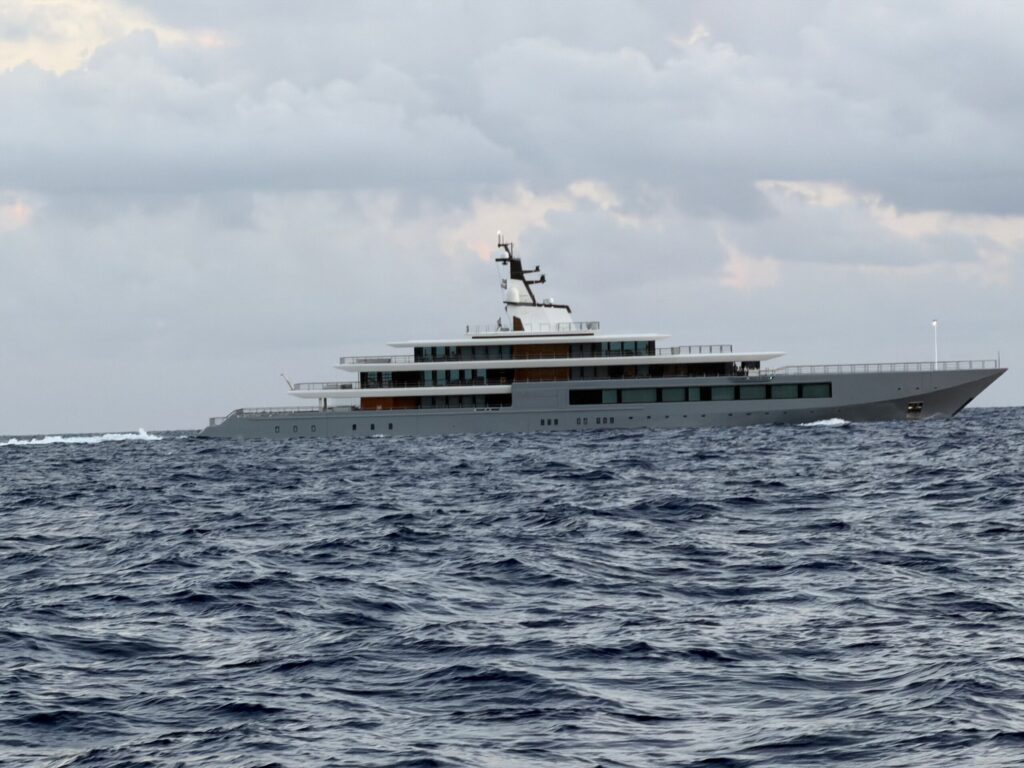
So get this. You can boat snoop. Just look up the boat’s name, conveniently displayed on the AIS, in your favorite AI tool or web browser. Try it with the above named boat, it’s awesome. Like looking at mansions on Zillow.
Your own 60‑foot boat, which felt pretty big at the dock, suddenly looks like the nautical equivalent of a well‑loved Honda Fit parked next to a Rolls‑Royce. His yacht is hundreds of feet long, with multiple decks, pools, hot tubs, a helipad, and a cinema where someone is watching one of his own movies while you’re reefing in the rain.
Same ocean. Very, very different scale.
But that’s part of the charm out there. One minute you’re alone in the middle of nowhere. The next, you’re sharing the sea with cargo ships, tankers, superyachts, and a lone other sailboat tirelessly plugging along. You all pass each other and disappear back into your own little worlds.
2100 Down, 700 To Go
We are now about 700 miles from the finish line. I told Traci last night that as soon as I hit port I am making a beeline for a pizza as big as my head and a bucket of mai tais. After I shower.
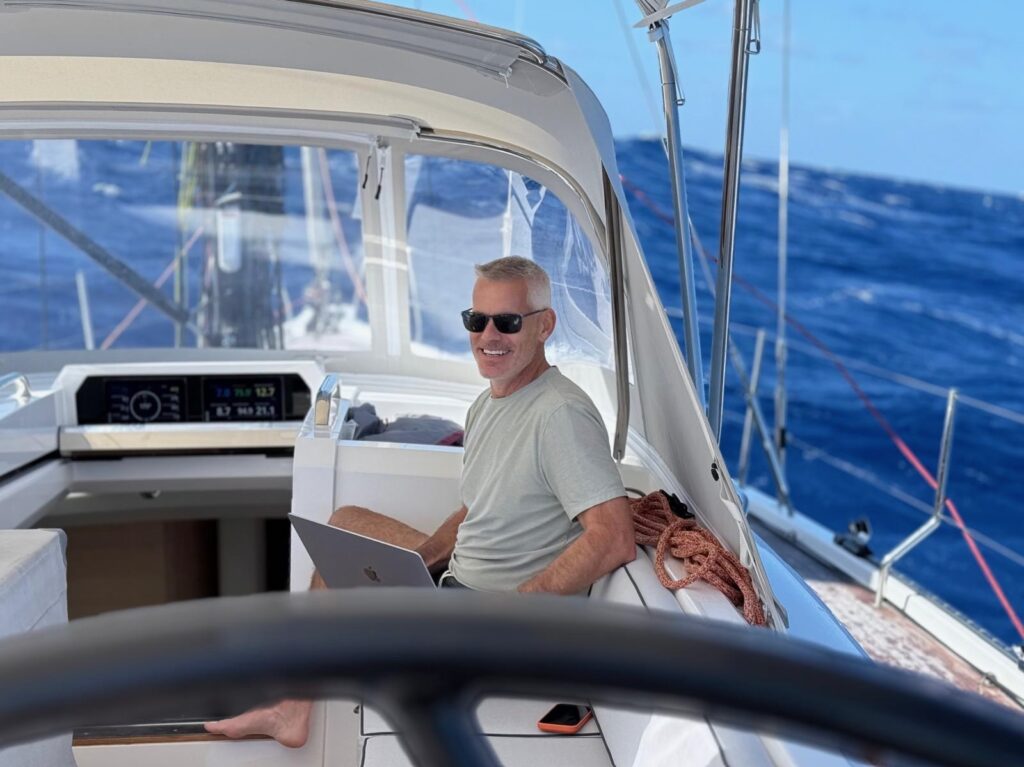
Continued thanks to the crew of Welcome for this truly once‑in‑a‑lifetime opportunity.
And yes, I mean that in both senses. 🙂
Love from the Atlantic.


Leave a Reply